


Ontario Heritage Centre
The Canadian Birkbeck Investment and Savings Company was the initial owner of what is today the Ontario Heritage Centre — the Ontario Heritage Trust's headquarters.
Street address:
10 Adelaide Street East
Toronto, Ontario
Email:
Publicly accessible?
No
Telephone:
416-325-5000
TTY:
711-416-325-5000
 Adaptive reuse
 Full wheelchair access
 National Historic Site (Canada)
 Site is protected by the Ontario Heritage Trust
 Washrooms
 Photography allowed
 Rental opportunities
When the principals of the Canadian Birkbeck Investments and Savings Company decided in 1907 to build their new office building, they chose a highly desirable site. 10 Adelaide Street East was a stone's throw from Yonge and King streets. A busy streetcar ran along Adelaide and the new location would benefit from the daily traffic of the nearby Post Office, Courthouse and several other financial institutions.
The Canadian Birkbeck Investment and Savings Company was the initial owner of what is today the Ontario Heritage Centre — the Ontario Heritage Trust's headquarters. The Company was one of a group of financial institutions that emerged in the late 19th century to provide mortgages and debentures. In keeping with a common practice of the day, the Company required a building that would house not only its banking services and corporate offices, but would also include several floors of rental office space that could be used as a source of revenue and future expansion space.
Award-winning Toronto architect George W. Gouinlock had just achieved prominence when he was commissioned to design the Company's new headquarters. He already had three bank buildings to his credit by this time. The Birkbeck Building represents Gouinlock's earliest use of the beaux arts style of architecture that was becoming popular with financial institutions for the image of stability and prosperity it projected. Built between 1908 and 1909, the building is a fine example of beaux arts architecture and construction methods considered to be state of the art at the time. The building's fireproofed steel structure with terracotta infill was no doubt a response to the Great Fire of 1904 that had devastated much of downtown Toronto. Gouinlock's initial design called for a seven-storey building. For reasons unknown, the additional storeys were not built.
10 Adelaide Street East remained the property of the Company and its successor, the Canadian Mortgage and Investment Company, until 1927 when the building was sold to the Standard Bank. Ownership of the structure subsequently passed to several corporations and individuals before the Ontario Heritage Trust purchased it in 1985.
The building has been designated a National Historic Site for its historical and architectural significance. It is owned and operated by the Trust. In addition to serving as the offices for the Trust, the building also provides conference and reception facilities.
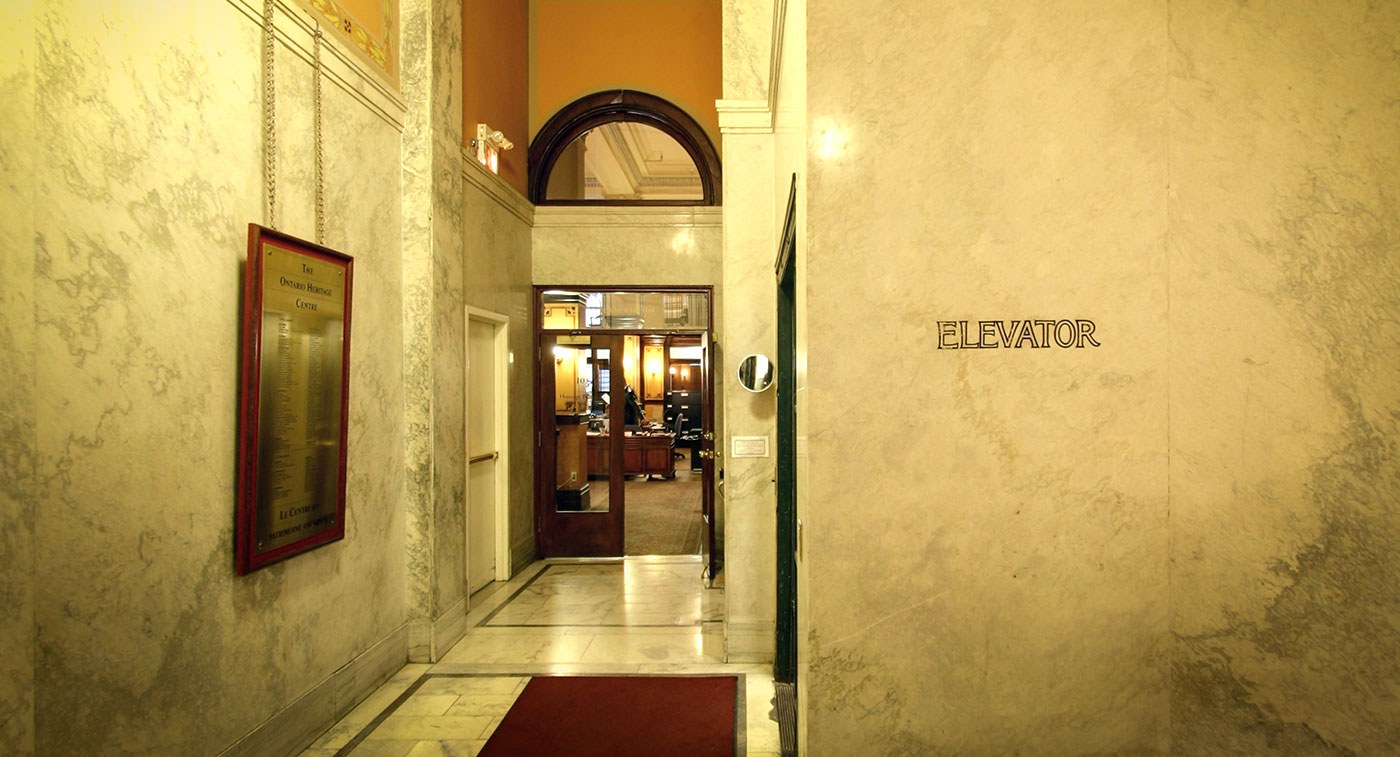
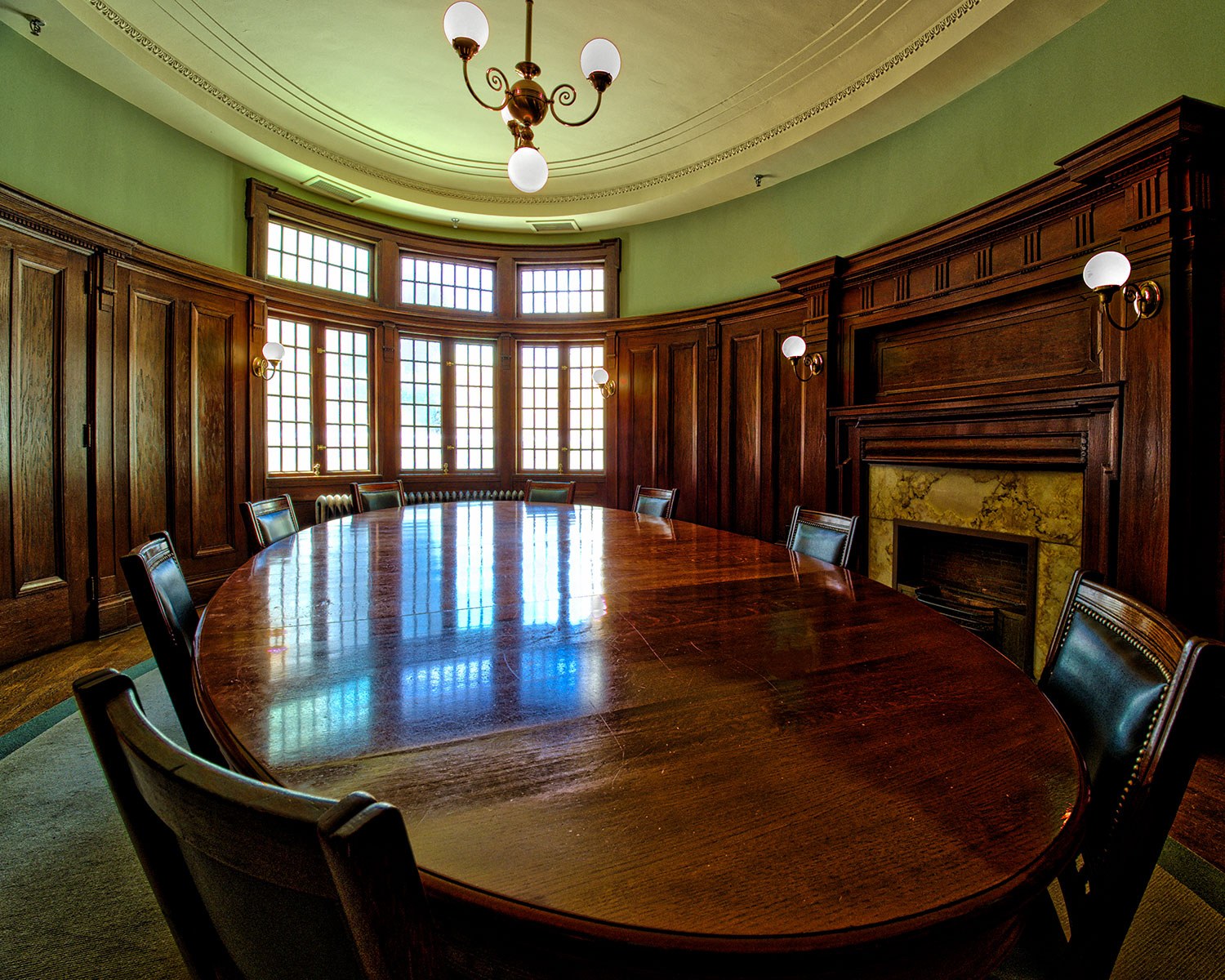
After its acquisition, considerable work was done to restore the building and demonstrate the adaptive reuse of a heritage office building. The Trust has maintained and re-instated original details, especially in the public areas of the lower two floors, allowing a genuine understanding of Edwardian architecture during one of Canada's most significant periods of growth. The restoration of the former banking hall (The Gallery) in 2002 incorporated traces of the many changes to the room while recovering the 1909 decorative scheme of the Birkbeck period.
Heritage conservation at work: Ontario Heritage Centre façade restoration project
From 2005-2007, the Ontario Heritage Centre underwent a significant façade restoration in three phases. Explore the work of the Trust in giving a facelift to this rare surviving example of a purpose-built Edwardian office building.
The Ontario Heritage Trust — the province's lead heritage agency — has commenced repairs to the south and west stone façades of the Ontario Heritage Centre.
This building — located at 10 Adelaide Street East in downtown Toronto — was originally the headquarters of the Canadian Birkbeck Savings and Investment Company. Built in 1908, the building was designed by noted Toronto architect George Wallace Gouinlock. It is a rare surviving example of an Edwardian office building and, for that reason, is designated a National Historic Site.
The Trust is dedicated to identifying, preserving, protecting and promoting Ontario's rich and varied heritage for the benefit of present and future generations. In 1988, the Trust acquired, restored and adapted the Birkbeck building for use as its headquarters, as a conference facility and to provide office space for non-profit and commercial tenants.
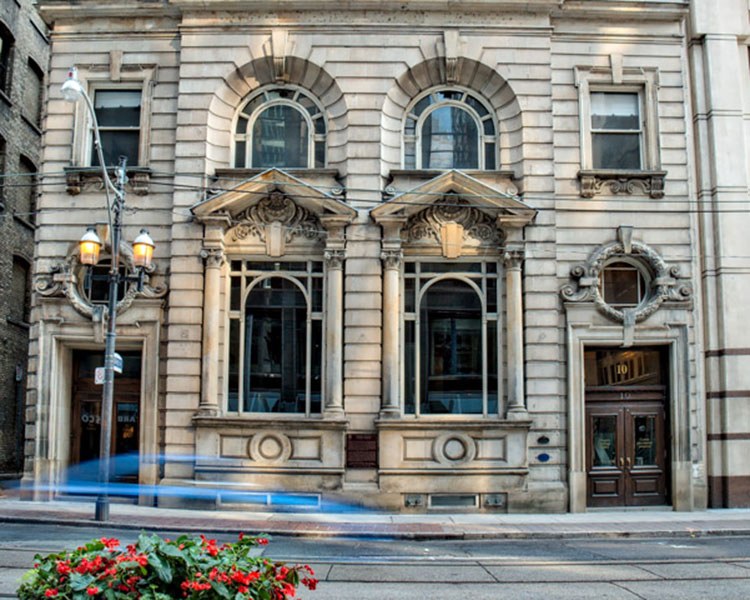
The composition of the front façade exhibits the symmetrical grandeur associated with the American Beaux Arts style. The projecting central bay features an unusual and dramatic pair of two-storey arched niches, each containing an aedicule (a temple-like element composed of a pediment supported on columns that stand on a projecting base). The vigorous banding of the façade and carved ornamentation limited to a few select windows is typical of Edwardian baroque style. The stonework also wraps around the southwest corner, enhancing the oblique view of the building from nearby Yonge Street.
The façade is made of both natural stone and artificial cast stone — in this case, a type that was sold under the brand name "Art Stone." In early 20th-century Toronto, artificial cast stone was a popular substitute for more expensive natural stone, particularly when many repetitive units were required. Reusable moulds meant that large quantities of ready-to-install cast stone could be produced more cheaply than natural stone, which had to be quarried and then dressed on the construction site by skilled stone masons.
This cast material was a mixture of cement, filler, pigment and aggregates that could be adjusted to provide a finished surface resembling granite, limestone or sandstone. The surface of the "stone" was often cast or incised after curing, with striations resembling the stone tooling of real stone. Even so, it remained more economical to carve individual one-off ornamental units out of natural stone. As a result, many cast stone façades are a combination of real stone and cast stone.
The Birkbeck Building is no exception. The repetitive "ashlar" blocks that compose the wall areas are all cast Art Stone. The carved sculptural elements — including window wreathes, door and window casings, pediment with tympanum beneath, columns and pedestal bases — are carved from sandstone.
During its almost 100 years of life, the Birkbeck Building has endured the wear and tear of many winters and freeze-thaw cycles, and the resulting water infiltration problems. A number of façade elements were replaced as they crumbled and failed. At some point, the whole façade was painted a light grey colour to hide accumulated dirt and to provide a uniform appearance.
In 2005, the Ontario Heritage Trust started planning a three-phase project to restore the façade in preparation for the building's upcoming centenary.
This restoration project was funded by the Government of Ontario.
Phase 1 involved the careful removal of paint layers from the south façade to reveal and assess the condition of the cast and natural stone in order to determine the most effective restoration approach. Many techniques were tested, including various peel-and-stick paint strippers, JOS low-pressure abrasive cleaning and low-pressure water cleaning. In the summer of 2005, the front façade was fully enclosed in scaffold and the paint layers were stripped, employing techniques suited to the existing material conditions.
Care was taken to remove only the paint layers — not the soot and atmospheric soiling beneath. This revealed a mottled, blackened façade as it would have appeared earlier in the 20th century when Toronto's atmosphere was polluted by coal burning. A close inspection of this soiling revealed a series of slash marks near the entrance doors and along the street level that bear witness to the early 20th-century use of sulphur-tipped matches, struck against the rough surfaces of the building to light cigars before entering the building to conduct business.
The cast stone and natural stone had weathered differently, the former turning a warm brown and the latter a charcoal grey. The condition of the upper two floors was poor. The lower two floors were in better condition. This variety of conditions presented a number of interesting architectural conservation issues. Should replacement units be made of natural or cast stone? To what extent should patina be preserved? Is a unified appearance desirable? The completion of Phase 1 raised as many questions as it answered.
Phase 2 of the project dealt with waterproofing the south foundation wall. In the spring of 2007, the sidewalk in front of the building was removed and the ground excavated down to footing level in order to repair the masonry foundation wall, to add layers of waterproofing and to install a new perimeter drain. This work was made more challenging by the discovery, beneath the sidewalk, of two window wells that originally allowed light into the basement level. They were constructed of brick with an inner lining of white ceramic tiles and were slung from the foundation wall with little support beneath. The waterproofing work was temporarily delayed while these interesting features were documented by a licensed archaeologist. With the "feet" of the building dry and the sidewalk reinstalled, plans were finalized to start actual restoration of the façade in Phase 3 of the project.
Phase 3, started in June 2007, will see the replacement of the cast stone of the upper two storeys of the south and west façades with new cast stone. This step is necessary because years of water damage and a patchwork of unsympathetic repairs render much of the wall unsalvageable. The cast stone and natural stone of the lower two storeys are being largely retained and repaired, in each case with similar materials. The first course of stone at the base of the building will also be replaced with natural stone to return it to its earlier appearance. All of the masonry is being cleaned and treated to return the façade to a unified appearance, while retaining some of the patina of the last 100 years.
The Ontario Heritage Trust is proud to have initiated this project that will ensure the preservation and continued use of this significant National Historic Site.