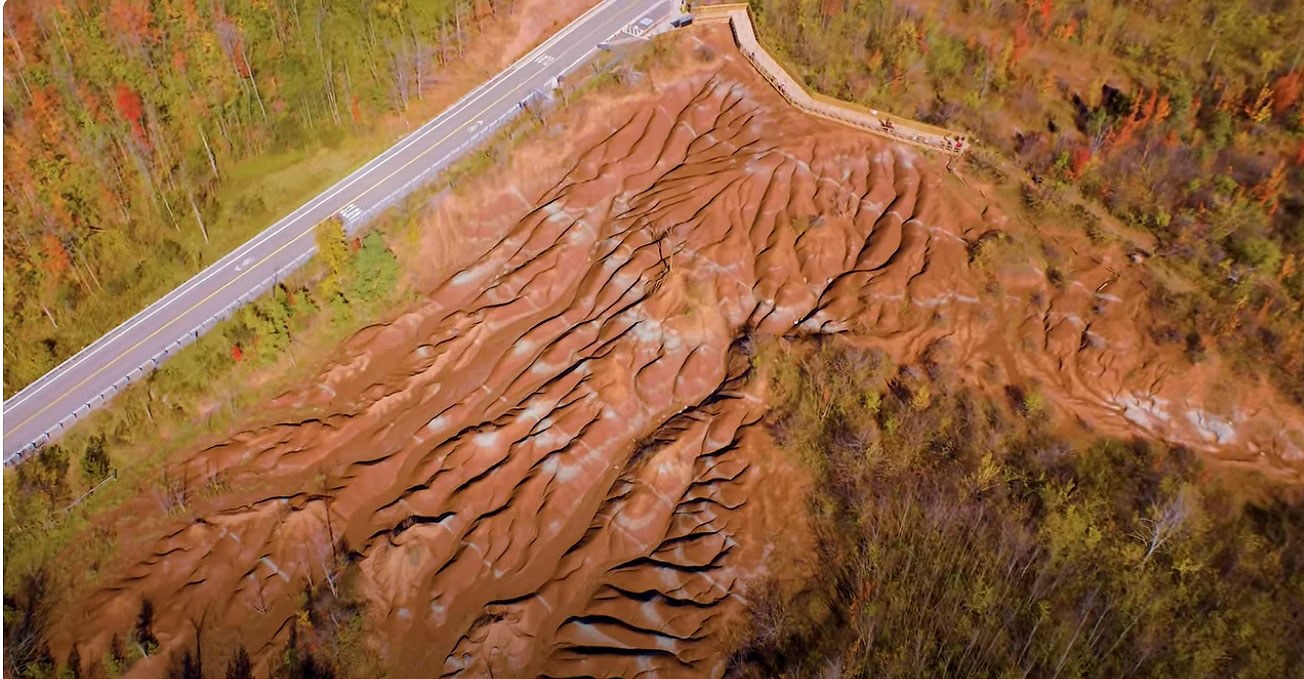


Cheltenham Badlands
The Cheltenham Badlands site is one of Ontario’s geological treasures, formed at the base of an ancient sea about 450 million years ago. Today, this 36-hectare (91-acre) site is one of the most recognizable and visited natural heritage landmarks in Southern Ontario.
Street address:
1739 Olde Base Line Road
Caledon, Ontario
Hours:
May 9 to November 17, 2025, dawn to dusk
By reservation only
Entrance fees:
Entrance fees are charged per vehicle. All transactions must be made through ParkPass. Most bookings are for 90 minutes. Limited spots are available, however, for three-hour bookings.
- Monday to Friday: $10 + HST for 90-minute visit
- Weekends and holidays: $20 + HST for 90-minute visit
- Monday to Friday: $18 + HST for three-hour visit
- Weekends and holidays: $35 + HST for three-hour visit
Note: FREE 1.5-hour parking for Canadian Armed Forces veterans. Email us to secure your spot. You may be asked to present your service card to gain entry.
Portable washrooms available on site
 Kid friendly
 Parking
 Partial wheelchair access
 Self-guided tours available
 Washrooms
 Photography allowed
Make your booking today
Entrance fees are charged per vehicle. All transactions must be made through ParkPass.
Most bookings are for 90 minutes. Limited spots are available, however, for three-hour bookings.
See above for rates.
Make your booking today
: Make a bookingAncestors of the Mississaugas of the Credit arrived here in the 1700s to hunt, fish and forage. They set up small, temporary villages on the river flats and practised horticulture, seasonally migrating and living lightly on the land. They stewarded this land over many generations, and it remains within their traditional territory.
European settlers cleared the land to establish homesteads and farms. From around 1850 to 1950, crops such as winter wheat, oats, potatoes and peas were grown here, and cattle grazed on the property. Signs of the apple orchard and a stone foundation from one of the original buildings still exist on the property.
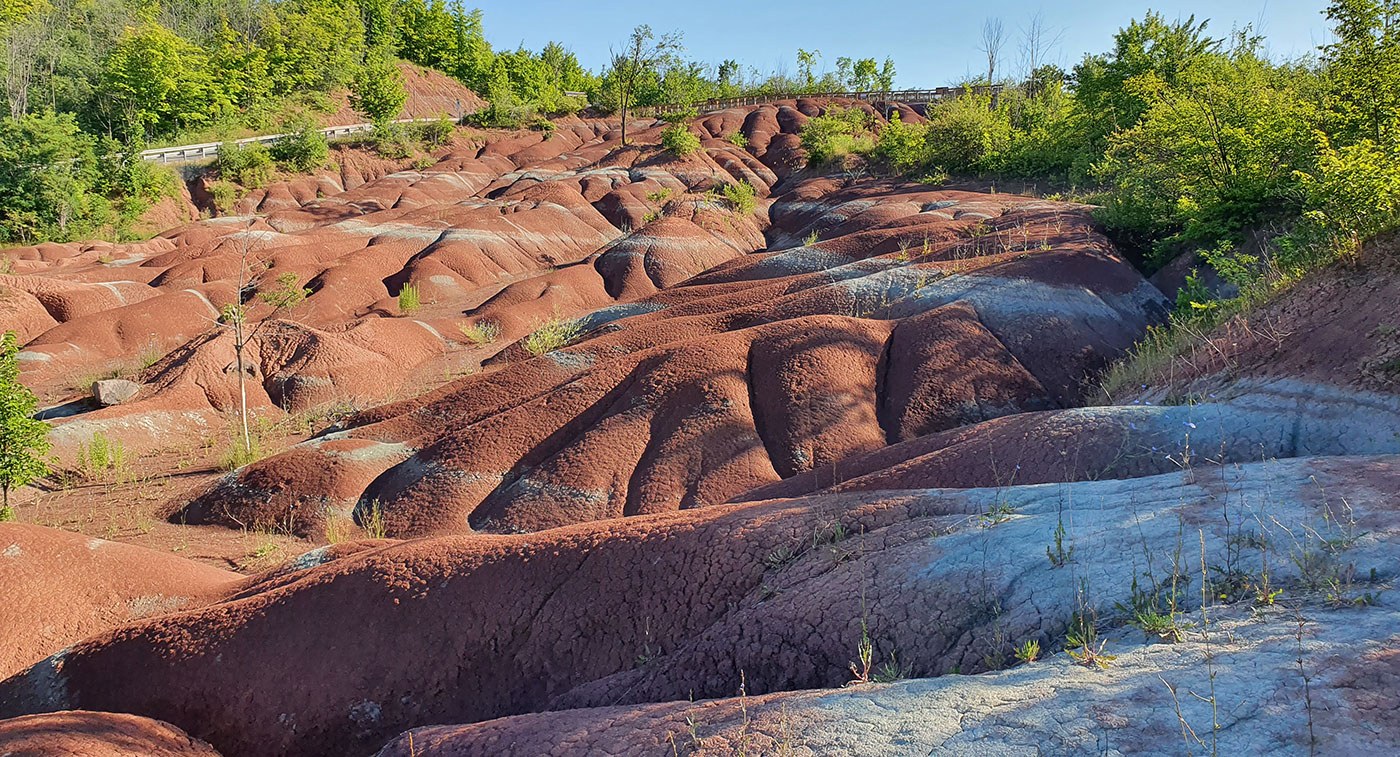
The removal of trees and early farming practices caused the shallow topsoil to erode away, in turn exposing the underlying Queenston shale. Rain, snowmelt and freeze-thaw conditions accelerated the erosion of the shale, resulting in the unique ridge and gully landscape that you see today — known as the Cheltenham Badlands.
Since being exposed in the early 1900s, the shale eroded into a series of hummocks and gullies, producing the current distinctive landscape. Approximately 20 per cent of the property consists of badlands topography; the remaining portions of the site include mature forests, wetlands and regenerating cultural woodland. The property was acquired by the Ontario Heritage Trust in 2002 in collaboration with the Bruce Trail Conservancy and the then-Ministry of Natural Resources.
In June 2015, the Cheltenham Badlands closed to the public due in part to the accelerated erosion caused from increasing numbers of visitors. The Ontario Heritage Trust has been conducting research to monitor the geological and ecological change over time, as well as conservation and site improvements to protect the Badlands from further erosion. These important works are being implemented in partnership with the University of Toronto, the University of Waterloo, Credit Valley Conservation, the Region of Peel, the Town of Caledon and Bruce Trail Conservancy.
The Ontario Heritage Trust — along with Credit Valley Conservation and the Bruce Trail Conservancy — reopened the Cheltenham Badlands in 2018. The Trust assumed operation of the site in 2024.
Heritage significance
The Cheltenham Badlands property is designated as a provincially significant Earth Science Area of Natural and Scientific Interest. Due to its importance as a groundwater discharge area (groundwater emerges from the escarpment into streams), the property is also recognized as an Environmentally Significant Area. The cold-water stream on the property at the foot of the exposed badlands is a tributary of the Credit River. Different varieties of rare and uncommon flora thrive in and around the Badlands.
Recent conservation work
The Cheltenham Badlands is a unique and spectacular natural landscape feature that was at risk of damage from intense public use.
The Cheltenham Badlands Management Planning Team worked closely together with the Ontario Heritage Trust to plan for the long-term conservation and interpretation of the Badlands property. The Trust is grateful to Credit Valley Conservation, the Bruce Trail Conservancy, the Town of Caledon, the Region of Peel, the Mississaugas of the Credit First Nation, the Caledon Countryside Alliance and the University of Toronto.
Hiking | Dog walking | Birding | Photography and filming
You cannot use the Parks Pass from Credit Valley Conservation (CVC) or the Toronto and Region Conservation Authority to visit the Cheltenham Badlands. The Badlands is owned and operated by the Ontario Heritage Trust and access to the site can only occur through the online reservation system, ParkPass.
Also, because CVC is no longer affiliated with the Cheltenham Badlands, reservations for the Badlands do not also grant access to Island Lake Conservation Area or Terra Cotta Conservation Area. CVC made this offer previously to visitors when they managed the Badlands, but the same offer is no longer available.
Drones are not permitted on the Badlands property.
At this time, we are not able to issue any special use permits such as group bookings, events or photography.
There are two ways to walk to the boardwalk feature from the parking lot. The direct route along the sidewalk on Olde Baseline Road is approximately 250 metres (820 feet) to the boardwalk and feature. There is also a Badlands trail through the forest that provides a more immersive experience. The Badlands trail is a 320-metre (1,050-foot) nature trail. This is not recommended for individuals with mobility issues. Please note that the trail can be muddy due to the nature of the clay soil.
Reservations are required to access the parking lot and must be booked before your visit. To avoid issues, all parking reservations should be made in advance using our online booking service, ParkPass. For those who enter their licence plate numbers, the gate should scan your licence plate and open automatically. Alternatively, you can pay for a parking reservation on arrival to the Badlands through the online ParkPass booking system (cellular internet connection required). Online payment options include debit or credit card. No cash or cards are accepted at the Badlands parking lot. All purchases are done through the website.
If you don’t know your vehicle’s license plate number when booking (for example, you are using a rental vehicle), simply enter any combination of four letters and three numbers into the ParkPass system (e.g. ABCD 123). When you arrive, the gate will not recognize your license plate, but you can still enter the parking lot by scanning the QR code or entering the PIN included with your booking confirmation.
Note that only regular-sized vehicles are permitted — no RVs, buses or trailers allowed. The spaces in the parking lot cannot accommodate larger vehicles and trailers. Admission also only covers the occupancy of one space.
Motorbikes are allowed in the parking lot, but you will need to use the QR code or the pin code on your booking confirmation email to open the gate as the reader cannot see the license plates on motorbikes.
Bicycles are allowed on the site. There are bike racks available in the parking lot. Note: There is no charge for those who visit on bicycle or on foot.
The accessible parking space is available to use on the weekends by reservation only. The accessible space may be used only by vehicles displaying a valid accessible parking permit and proof of permit will be required. When you arrive, please go to the main parking lot and speak to the security agent who will move their vehicle from the accessible space. From the accessible parking spot, it is about 15 metres (50 feet) or more to the boardwalk. To use the space during the week, it is available on a first come, first served basis.
The Badlands feature is a provincially significant Area of Natural and Scientific Interest. Its distinctive hills and gullies showcase Queenston shale, which is as striking as it is delicate. Erosion is what first exposed the shale after decades of human and environmental activity, and any trespassing onto the Badlands will further erode this unique landmark.
It is important to stay on designated trails, boardwalks and sidewalks.
Boardwalk (60 metres/197 feet)
The accessible viewing platform extends across a portion of the Badlands to ensure its protection. Remain on the platform. Walking on the Badlands itself is strictly prohibited.
Badlands trail (0.32 km/1,050 feet)
This trail connects the Bruce Trail to the viewing platform. The route takes you through a young forest habitat full of native trees and shrubs.
Bruce Trail (1.33 km/1,455 yards)
The Bruce Trail is Canada’s oldest and longest marked footpath. This part of the trail connects and passes through the Badlands and takes you through hawthorn, ash and apple trees and over a tributary of the Credit River.
For general inquiries, email badlands@heritagetrust.on.ca. Please note that we are only able to respond to emails during regular business hours, Monday to Friday between 9 a.m. and 5 p.m.
You can make changes to your booking by clicking the “view or make changes to your reservation” link that can be found in your confirmation email. Please note that the cancellation policy does not allow for any changes to the date and time of your reservation within 48 hours of your scheduled booking time. Refunds are also not permitted within this timeframe.
If you made an error when making your reservation — such as an incorrect email address or licence plate number — you still have options. As long as you have entered the correct licence plate number, the gate should open automatically when you arrive for your visit, so there is no need to do anything even if you did not receive the confirmation email. If you didn’t enter your licence plate number (or entered it incorrectly) and didn’t receive your confirmation email, please email us as soon as possible so that we can reissue the confirmation.
Preserving the Badlands
The work of the Trust in conserving Ontario’s heritage would not be possible without the support of donors, corporate sponsors and partners across the province. Your support will ensure that the Cheltenham Badlands are enjoyed by future generations.
Make a donation to help protect the Badlands and many more of Ontario's natural heritage spaces.
Over the course of several years — as required under the Niagara Escarpment Plan — the Trust, alongside eight partner organizations as part of the Cheltenham Badlands Management Planning Team (CBMPT), led a comprehensive public consultation and planning process to produce a final Master Plan (PDF | 9 MB) to guide property management and site development for the next 10 years.
The long-term goal for the Cheltenham Badlands Master Plan is to protect and enhance the site’s unique natural and cultural resources while providing opportunities for the public to appreciate its outstanding scenic beauty and participate in passive recreational activities. The Ontario Heritage Trust, with its property partners — the Credit Valley Conservation and the Bruce Trail Conservancy — will manage the property with this vision and long-term goal in mind and facilitate safe and controlled access for the public by improving accessibility and viewing through a system of boardwalks and trails. These improvements at the Badlands will help to preserve the site for future generations.
We would like to thank everyone who helped shape the vision and Master Plan for this uniquely beautiful site for their feedback, advice and input.
Master Planning process
The CBMPT developed four guiding principles for its work in developing the Master Plan. These principles align directly with the Trust’s mandate and provided useful focus to the Master Plan discussions:
- conservation of the property’s cultural and natural heritage values
- safety for all individuals who visit the site
- improved accessibility for those who wish to access the site
- enhanced opportunities for interpretation and public education
The Master Plan process was separated into four keys stages that began with gathering background information and identifying potential development opportunities and constraints on the Badlands property. At each stage, the Trust consulted with the public and stakeholders to present important information, analysis and develop options to enhance the visitor experience. The badlands property is located on the traditional territory of the Mississaugas of the Credit First Nation (MCFN). Engagement with the MCFN was conducted throughout the Master Plan process and focused on their interest in ensuring protection for the natural heritage of the site and assisting with the interpretation of its cultural heritage. Local business, residents, academics, accessibility committees and local municipal staff and conservation organizations all contributed to shaping the final, optimal solution for the Badlands.