

Niagara District Court House
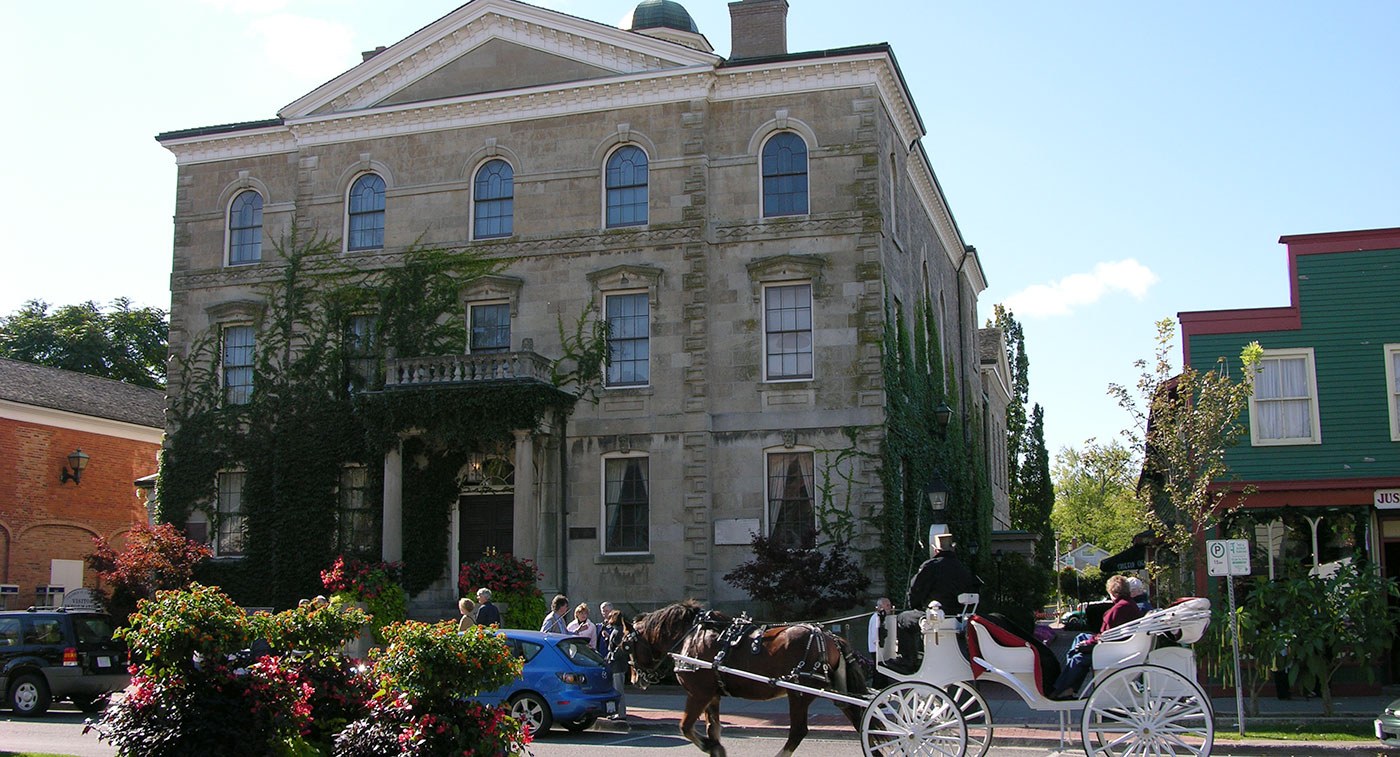
This building is associated with 19th-century judicial, governmental and administrative development in Ontario and is the third and only surviving courthouse erected for the former Niagara District. Its plan marks a transition to larger and more sophisticated court buildings after 1850 in order to include a wider range of functions.
Street address:
26 Queen Street
Niagara-on-the-Lake, Ontario
Publicly accessible?
Yes (limited)
The Ontario Heritage Trust holds a conservation easement on this property.
Check this website for hours and admissions.
Learn more about the provincial plaques at this site — The Niagara Library and Ontario's First Provincial Parliament
 Adaptive reuse
 National Historic Site (Canada)
 Partial wheelchair access
 Site has blue and gold provincial plaque
 Site is protected by the Ontario Heritage Trust
 Photography allowed
In 1817, a courthouse and jail for the District of Niagara was built in an isolated section of the Village of Niagara. In 1841, the managerial functions of the justices of the Quarter Sessions of the Peace were taken over by elected district councils. The new councillors immediately began to complain about the small quarters and inconvenient location of the old Niagara courthouse. Municipal authorities – eager to consolidate its position as the judicial seat, and fearing that St. Catharines with its strategic position on the Welland Canal would soon surpass their town – initiated the construction of a new courthouse. This project was part of a plan to maintain Niagara's position as the political centre of the district. Specifications for the building required space for a courthouse, offices, jail, town hall and market place. In 1863, the seat of judicial power was moved to St. Catharines. The Niagara District Court House was used as a town hall and now houses the Shaw Theatre.
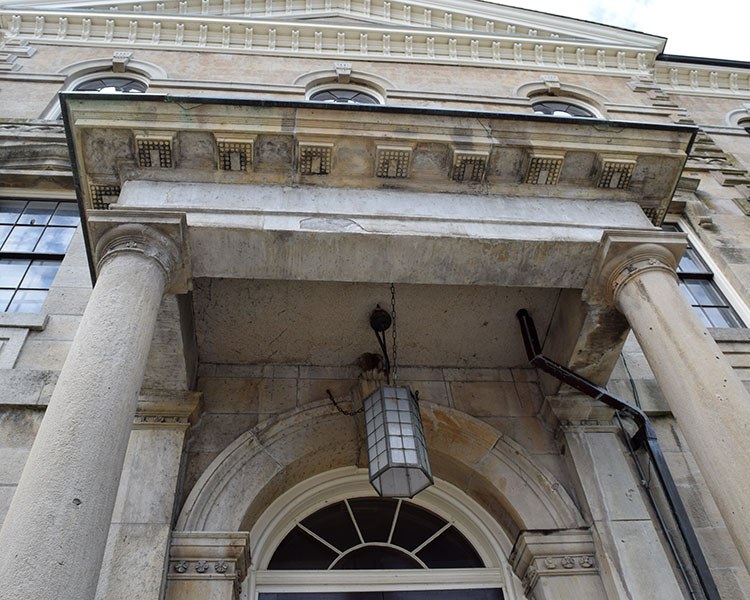
Designed by prominent Toronto architect William Thomas in the Neo-classical style and built by Garvie and Co., this three-storey building is distinguished by its projecting frontispiece with a heavily bracketed cornice and pediment, and its main entrance porch with an overhead stone balustrade supported by Doric columns. The window openings on the front elevation are round headed on the third floor and square headed on the first and second floors. The second-floor window openings are detailed with pedimented hoods. The corners of the front elevation and the frontispiece have decorative quoins. The interior joinery was carried out by John Davidson. The second-floor courtroom was elaborately designed and decorated with a central domed ceiling.
In 1978, the Town of Niagara-on-the-Lake designated the courthouse under the Ontario Heritage Act and, in 1980, the building was designated a National Historic Site. In 1988, the Ontario Heritage Trust secured a heritage easement on the building.