On June 28, 1914, radical Serbian nationalists assassinated Archduke Franz Ferdinand in opposition to Austro-Hungarian imperialism. The assassination triggered a regional war in the Balkans, but a cascade of events in July escalated the conflict into an international war.
The British empire was pulled into this vortex of war on August 4. The official reason for their involvement was to honour the Treaty of London by protecting Belgium’s territorial sovereignty. The United Kingdom also had a diplomatic agreement with France — called the Entente Cordiale — to defend one another from German aggression. As a Dominion of the British Empire, Canada automatically joined the war following the entry of the United Kingdom. When the news of the war reached Ontario, there were some patriotic festivities, but for most Ontarians, the announcement of war was seen as a dreadful development.
Before 1914, a war between the British and German empires had been feared for many years. British author H.G. Wells was among those convinced that unchecked German expansion would usher in a new dark age. With the war against Germany now a reality, Canada’s federal parliamentarians assembled for an emergency session. Politicians on both sides of the House rallied to the cause and professed their wholehearted commitment to the Allied war effort. As they proclaimed in their speeches, the war was a noble struggle to defend peace and democracy against German autocracy and militaristic culture. Pacifist and radical groups contested this view, but for most Ontarians, the Great War was a righteous struggle from beginning to end.
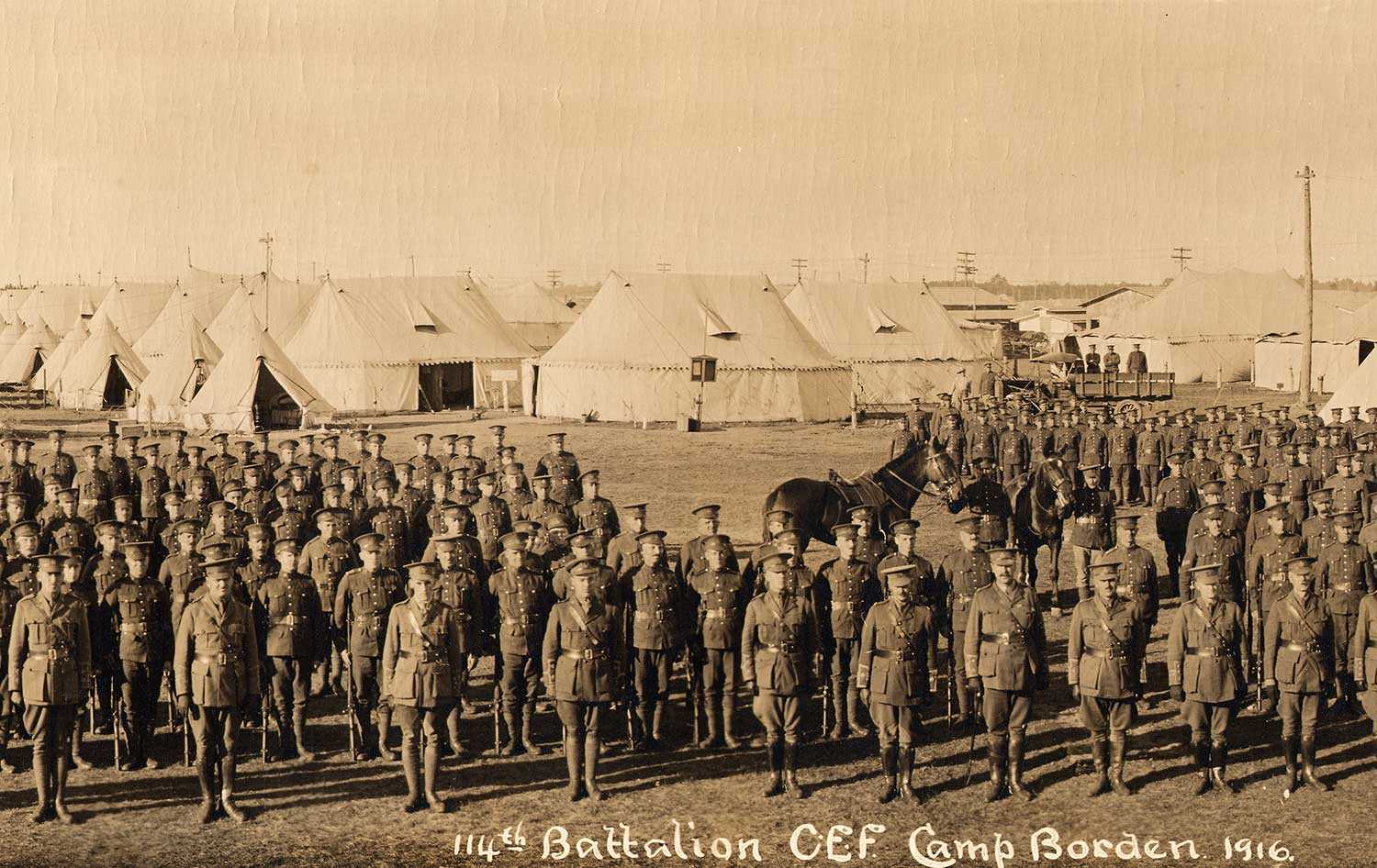
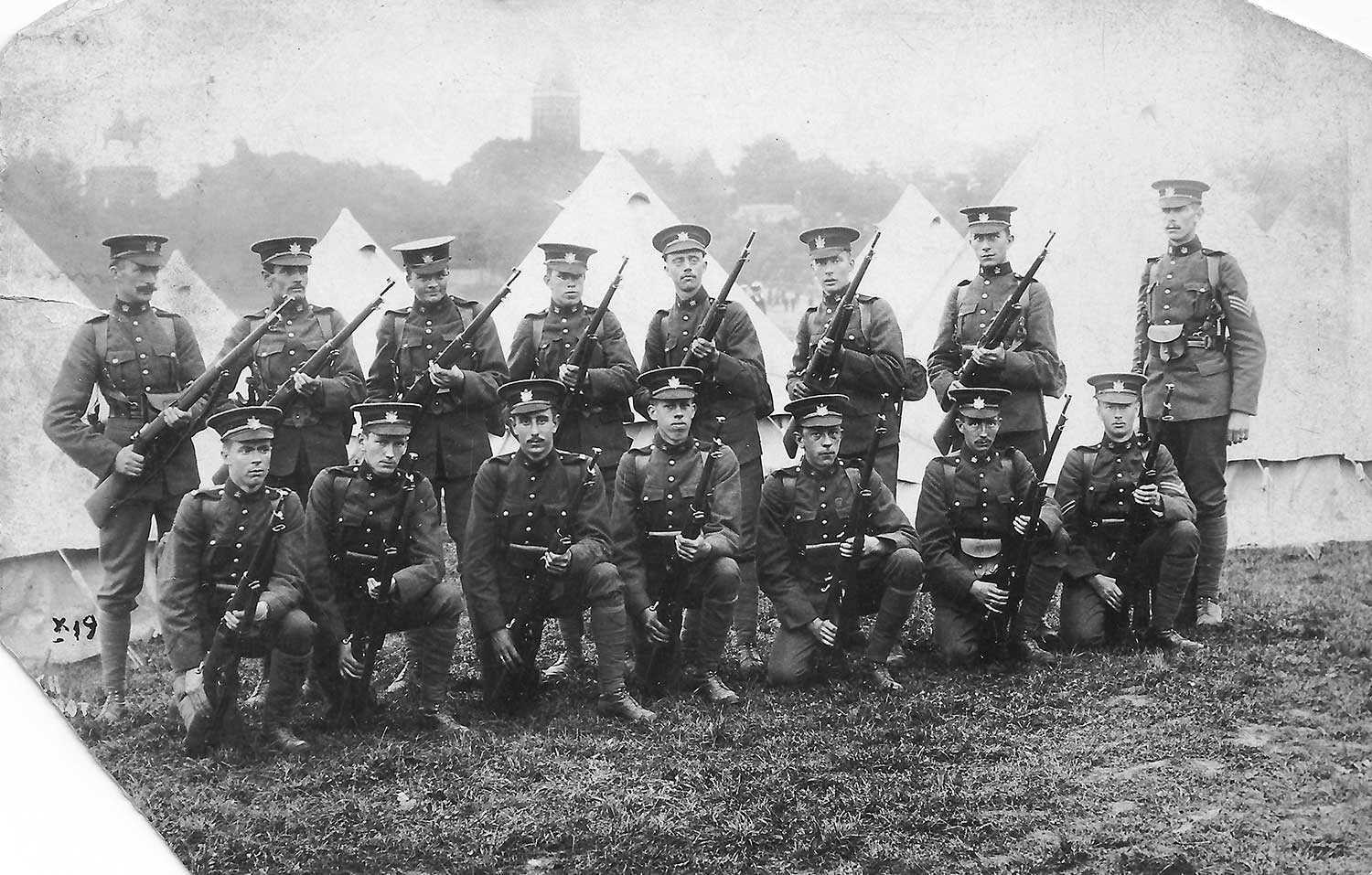
Throughout the war, Ontario was far from the fighting on land, sea and air, but the province was still profoundly impacted by mobilization and sacrifice. To exemplify the war’s scale and intensity, we can consider Ontario’s contributions to the Canadian Expeditionary Force (CEF). In total, 201,671 male volunteers were recruited in Ontario alone — 153,029 of whom were born in the province. This contribution represented 41.8 per cent of the total voluntary force and one-third of military-aged males in the province. In addition, Ontario provided 32 per cent of conscripts (39,869) and 44.6 per cent of Nursing Sisters (1,115). Nearly three-quarters of Ontario’s recruits served overseas.
On the Western Front, the CEF’s first major engagement against the German army occurred in March 1915 in the French town of Neuve Chapelle. The CEF was tasked with obstructing German reinforcements while the British 1st Army attempted to break through the German frontlines. The offensive failed to achieve its primary objective, and the CEF suffered 100 casualties. The following month, the CEF participated in the Second Battle of Ypres. During this brutal battle, Canadian soldiers were the first to experience the horrors of chlorine gas and the waves of German attacks that would follow. Canadian soldiers held off the German offensive until British and French reinforcements arrived, but at a high cost. Over 2,000 Canadian soldiers were killed and an additional 4,000 injured.
Throughout the war, the CEF would play critical roles in major battles, including the battles of St. Eloi (1916), Mount Sorrel (1916), the Somme (1916), Vimy Ridge (1917), Hill 70 (1917), Passchendaele (1917) and Amiens (1918) as well as engagements at Amiens, Cambrai and Mons during the Last Hundred Days (1918). These battles and this attrition would inflict devastating losses on the CEF. From Ontario, there were 22,183 fatalities, or 37.5 per cent of the CEF’s total. There are no estimates on the provincial distribution of non-fatal casualties, but it should be noted that over 172,000 men and women were wounded. Countless military personnel also suffered from post-traumatic stress disorder, known at the time as “shell shock.”
As the following sections explore, the Great War impacted Ontario’s economy, politics, social relations and culture. But perhaps the greatest change for many residents of Ontario was the loss of family and friends in one of history’s most terrible wars.



![Norman James holds the first shell manufactured in Toronto. (Photo: City of Toronto Archives, Fonds 1244, Item 852 Date: [1914?])](https://www.heritagetrust.on.ca/uploads/Exhibits/WW1-Munitions-factory-1500px.jpg)
![University of Toronto recruits drill on campus. (Photo: City of Toronto Archives, Fonds 1244, Item 763 Date(s) of creation of record(s) [1918?])](https://www.heritagetrust.on.ca/uploads/Exhibits/GW-military-recruits-U-of-T-1500px.jpg)