


The complexity of collaboration

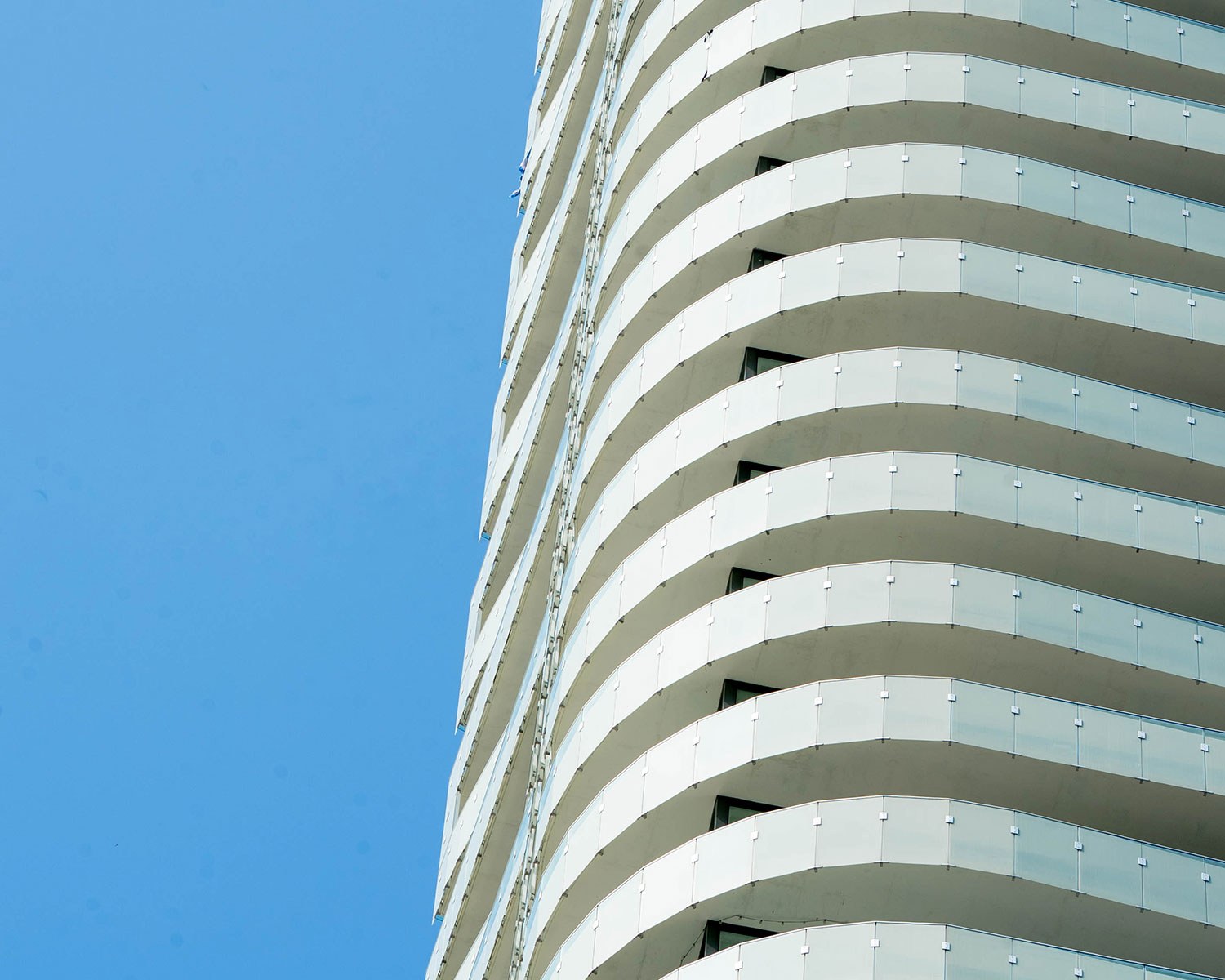
Massey Tower (detail)
The Massey Tower at 197 Yonge Street in Toronto is a condo that succeeds where many fail. Its design is informed by its context and it keeps itself firmly rooted in the heritage of its surroundings. As a result, the integration of modern skyscraper design and heritage buildings works in harmony to enhance a complex and layered historical area. In a city like Toronto, it takes a lot for a condo to achieve that.
Bounded by Yonge, Queen, Victoria and Shuter streets, the site of the condo development contains two National Historic Sites and several heritage-protected buildings. Dating from the late 19th and early 20th centuries, these buildings are extremely important in terms of architectural heritage, while also housing unique functions within the city. Massey Hall and the Elgin & Winter Garden Theatres are unmatched in significance with National Historic Site recognition. The condo development at 197 Yonge Street found inspiration in both the site and from this block’s unique heritage. The name Massey Tower is in recognition of the important performance space located next door. The development site was wedged between provincially and locally protected former bank buildings — one at 205 Yonge Street (designed by Old City Hall and Casa Loma architect E.J. Lennox and protected by an Ontario Heritage Trust conservation easement) and a municipally designated former bank building at 197 Yonge Street. In fact, this one block has no less than five municipally designated heritage buildings, two listed buildings and the two previously mentioned National Historic Sites.
Building a tall, modern structure within a tight urban site like this seems challenging enough. Doing so in a manner that embraces the area’s heritage in a convincing manner can be downright impossible. Often, the insertion of a tall residential tower into the heart of a city is done with a heavy hand. The site is cleared and the new building rises. If lucky, perhaps the façade of a heritage building will be retained and tacked onto the tower. Taking a surgical approach, on the other hand, is far less common. And doing so successfully is rare. The Massey Tower used the challenges of its location to inform its design and found success in providing a positive contribution to the city’s ever-changing skyline.
Back in 2012, when MOD Developments purchased the unoccupied and badly deteriorated 1905 former Imperial Bank of Commerce building on Yonge Street, it would be hard to imagine building much of anything there, let alone a 60-storey residential tower. Unless there was a wrecking ball in the mix, the area would not have seemed like an obvious candidate for adding density. The site was relatively small, included a tiny, unloved park, a number of protected heritage buildings and it was subject to several easements over the shared rear alley. Those site constraints actually fed and shaped the development and allowed for both award-winning design and the preservation of the site’s architectural heritage. It also brought all the neighbours to the table.
This is where the Ontario Heritage Trust (the Trust) comes in. Being responsible for the conservation and operation of the Elgin & Winter Garden Theatres, the world’s last operating stacked theatres, the Trust is interested in ensuring that any development happening at the building’s backdoor would protect this irreplaceable structure and allow for its operations as a theatrical venue to continue uninterrupted. The same considerations went for neighbouring Massey Hall, which was in the midst of planning its own long-awaited expansion and restoration. Within this unique set of circumstances, MOD Developments proved itself to be the right kind of development company to take on the challenges of the site. It was evident from the beginning that respect of the block’s built heritage wasn’t just an afterthought, it was a motivating factor in pursuing the project in the first place. In order to pull it off, a respectful and productive relationship with the many neighbouring properties was required.
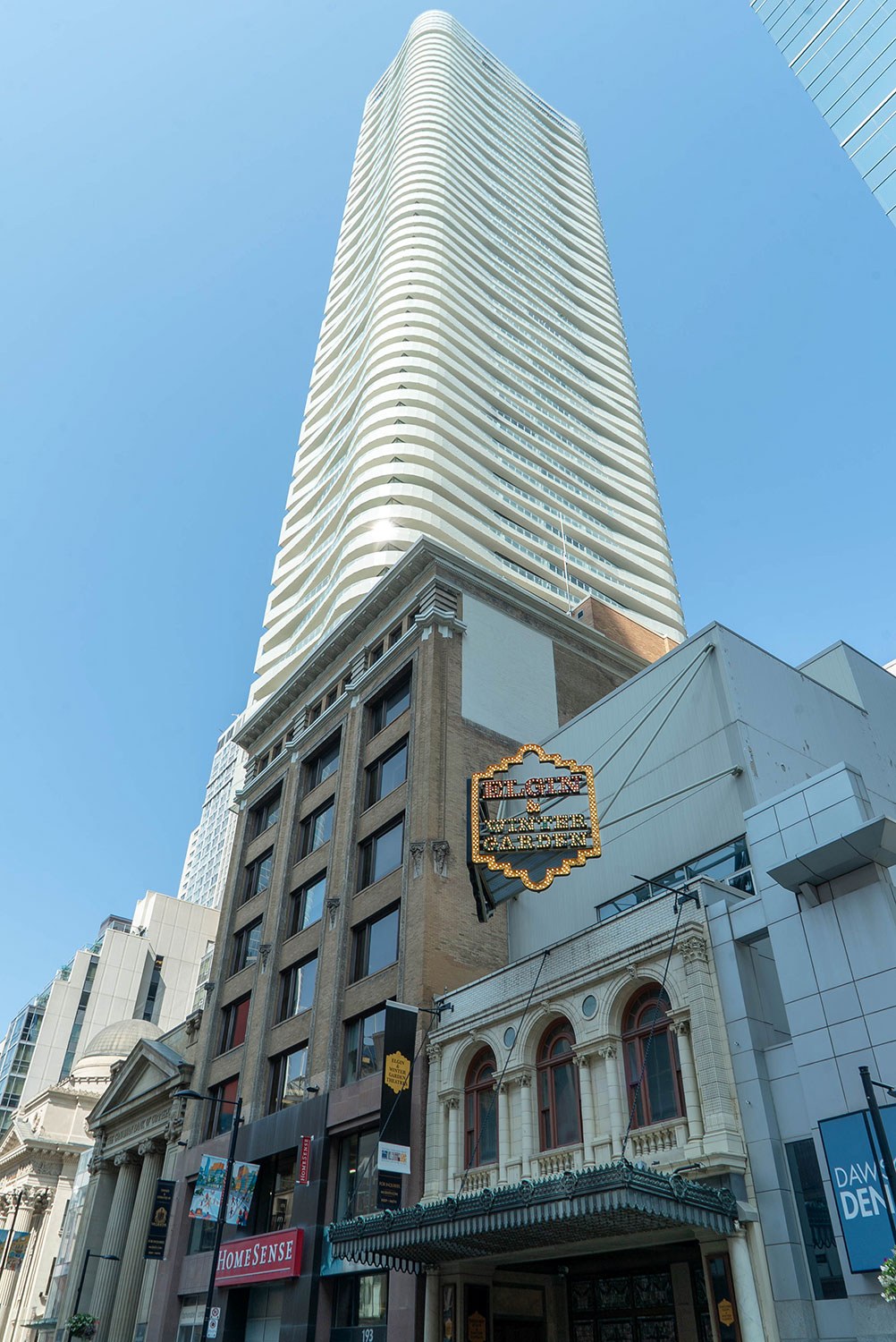
Massey Tower rising above the Elgin & Winter Garden Theatres
To that end, there was willingness on all sides to listen to concerns, discuss ways to mitigate them and come to a practical and legal understanding on how to manage change. This is something often missed in discussions about heritage. Contrary to popular opinion, heritage doesn’t prevent or discourage change. It simply informs and guides the process, often in a manner that improves the outcome on all fronts. In the case of the Massey Tower, it was possible to insert a slender residential tower among heritage buildings, restore one in the process and allow a level of harmony to exist between all neighbours.
Having said that, it was important that common understandings agreed upon during numerous meetings were backed by legal and binding agreements. In the case of the Trust, that meant protecting its vulnerable heritage building during the entire construction process and beyond. No less than seven legal agreements had to be made to protect the Trust’s interests and allow the project to proceed with certainty. Municipal approvals played a considerable role, too, but it was the productive and collaboratively written agreements that ensured that the Trust’s interests were protected while providing MOD (and Massey Hall) the certainty on how to proceed.
In addition to this, there were opportunities for the Trust to leverage the development to improve and protect operational requirements. A jumble of existing easements for access and use of spaces with numerous parties was streamlined, areas within the condo were created for theatre garbage storage and the building was protected with both pre- and post-construction condition assessments as well as ongoing monitoring and regular touchpoint meetings with the developers.
Within the condo itself, the discovery of a beautiful and original mosaic floor inside 197 Yonge Street was used as an unexpected opportunity to incorporate more heritage conservation into the condo’s lobby beyond original features already planned for preservation.
As a result of careful design, prudent planning and — above all — the establishment of a productive and professional working relationship, the Trust and the developers were able to turn a complex proposal into a productive outcome, proving that developing land, preserving heritage and maintaining neighbourly relationships are not exercises in opposition.