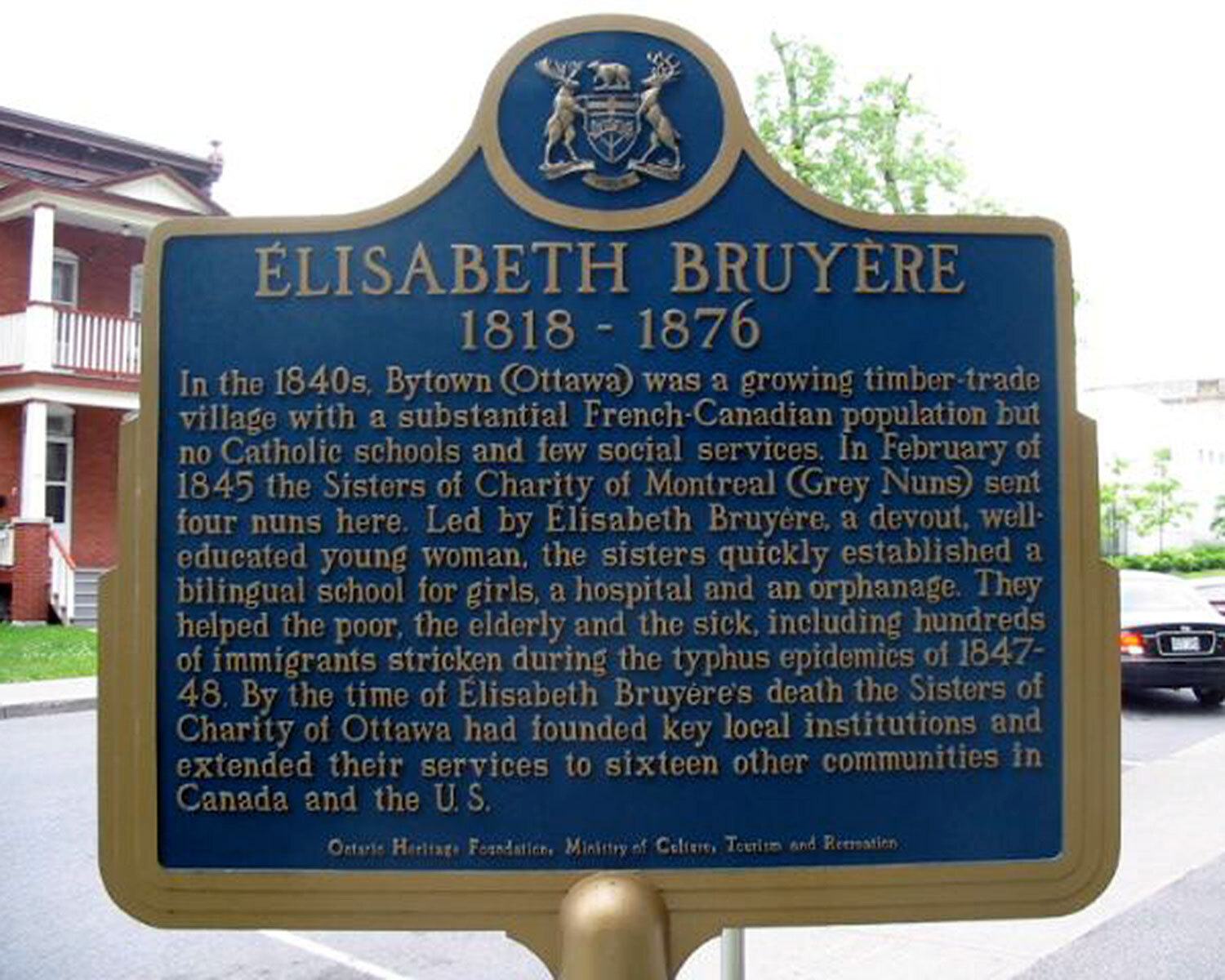


Elisabeth Bruyère 1818-1876
Ottawa in the 1840s (still Bytown then) was a growing timber-trade village with a substantial French-Canadian population but no Catholic schools and few social services. In 1845, four nuns, led by Bruyère, arrived and establish a school, hospital and orphanage, as well as established many social services.
Location:
In front of the Chapel of the Sisters of Charity, 25 Bruyere Street, Ottawa
Themes:
Franco-Ontarian heritage, People, Religion, Women's History
Plaque text:
In the 1840s, Bytown (Ottawa) was a growing timber-trade village with a substantial French-Canadian population but no Catholic schools and few social services. In February of 1845 the Sisters of Charity of Montreal (Grey Nuns) sent four nuns here. Led by Elisabeth Bruyère, a devout, well-educated young woman, the sisters quickly established a bilingual school for girls, a hospital, and an orphanage. They helped the poor, the elderly and the sick, including hundreds of of immigrants stricken by the typhus epidemics of 1847-48. By the time of Elisabeth Bruyère's death the Sisters of Charity of Ottawa had founded key local institutions and had extended their services to sixteen other communities in Canada and the U.S.